Showing posts with label Reading. Show all posts

Monday, April 20, 2020

Extra Credit Reading Notes: Mahabharata Part D

Hello VagaBuddies!

Finally, after much anticipation, I finished the Mahabharata! Things got pretty crazy here in real life (or IRL as the bloggers say). Not to date this blog or anything, but I am currently writing this post while in quarantine for coronavirus! Scary! But also a good time to catch up on readings, because it is important to finish the story!  Here are some thoughts on the thrilling conclusion of the Mahabharata!

Where I left off in my last post (soooooo sooooo long ago), Yudhisthira and crew were starting their final and hardest year of exile: spending a year undercover in a city. With their silly disguises, they almost get caught so many times. Arjuna reveals himself to the boastful prince in order to save them both from an attack by Karna, and Yudhisthira is accidentally cut during a moment of anger from the King. Apparently (which I say because it was never mentioned before), if Yudhisthira's blood is spilled on the ground, a huge curse is put on the one who caused the wound. So Draupadi had to act quickly and catch the blood before it reached the ground. Phew!


Jun's Paper Stand 书报摊: Karna: The Mondern Man (Mahabharata ...
Arjuna and prince fighting Arjuna | paperstand.blogspot


One of the wilder parts of the big between the Pandavas and Duryodhana and crew is how they took down Drona, the old teacher of the Pandavas. To do this, they named an elephant after Drona's son, killed it, and then loudly proclaimed its death. Drona even asked Yudhisthira (who can't lie I guess?) if it was true, to which he replied, "yes," and then under his breath, "the elephant." This deception made Drona let down his guard for a moment in which someone else could come kill him. WILD

Overall, I thought the battle was meh. A good amount of action, but there were so many names that it was hard to really care about anyone in particular.

I also thought it was a bit selfish of Yudhisthira, whom I had consistently respected up to this point, to try to refuse the crown in favor of an ascetic life. He literally fought a war and then decided it wasn't worth it. Nice dude. I'm glad that Krishna was there to set him straight. It was also interesting to read how all the main characters passed, too. In the last couple pages, we saw how everyone else got their dignified deaths, and Yudhisthira actually just was raised into heaven.

Anyway, I am really glad I finished the Mahabharata, and, if forced to decide between recommending the Mahabharata or the Ramayana, it would be the Ramayana if for nothing else than the absolute gem of a character of Hanuman (What a hunk!)

Buon Voyage!


Mahabharata. Narayan. R.K. pp 131-179

Wednesday, April 1, 2020

Reading Notes: More Jataka Tales Part B

Hello VagaBuddies!

Welcome to the Reading Notes for Jataka Tales Part B! These stories were the spiciest stories out of all of them (And my favorite story of all the Jataka Tales!) Here is the reading list for this week:

Reading Part B
How the Monkey Saved His Troop
The Hawks and their Friends
The Brave Little Bowman
The Foolhardy Wolf
The Stolen Plow
The Lion in Bad Company
The Wise Goat and the Wolf
Prince Wicked and the Grateful Animals
Beauty and the Brownie
The Elephant and the Dog

One of the better stories in this reading was the story How the Monkey Saved His Troop, because I really liked the sacrifice that the Chief Monkey made to save his troop. However, I was curious about the actual distance between the trees. because if one monkey could stretch across and grip both ends, then surely all the monkeys could jump that distance!  Then the monkeys would be much easier saved, without needing the king to grant the chief monkey his life in order for everyone to make it out alive. Regardless, great story about heroism and bravery.

Without further ado, my favorite story: The Stolen Plow!  I loved this story so much mostly because I feel like I would react exactly as the second farmer would! I am not usually petty, but sometimes I get so in my head that I overreact! So when the first farmer stole the plow, and the second farmer reacted by stealing the other guy's fucking KID,  I instantly felt like I was the second farmer. And his response to the JUDGE was also so petty. Like imagine going up to a judge, someone who has the power to send you to prison, and you just use him as a way to further your petty plot. Imagine being called into a legal battle, and you bring up a completely separate incident as a justification for the current situation. It's ridiculous! And I loved it. 10/10 would definitely read more petty stories like this again.


Bibliography:
Babbit, Ellen C. "More Jataka Tales" http://www.gatewaytotheclassics.com/browse/display.php?author=babbitt&book=morejataka&story=troop


Reading Notes: More Jataka Tales Part A

Hello VagaBuddies,

In this assignment, I read even more Jataka Tales! I am really enjoying these quick little fables! Here are the ones I read for this post:


Reading Part AThe Girl Monkey and the String of Pearls
The Three Fishes
The Tricky Wolf and the Rats
The Woodpecker, Turtle, and Deer
The Golden Goose
The Stupid Monkeys
The Cunning Wolf
The Penny-Wise Monkey
The Red-Bud Tree
The Woodpecker and the Lion
The Otters and the Wolf

One story that threw me off this week was the story of the Golden Goose. I felt like I knew what this story was going to be about, but instead the goose was a personified character and not just the possession of the woman like I had expected. However, it still ended in a way that I could predict, with the woman becoming too greedy and capturing the goose. Unfortunately for her, the goose's golden feathers stop being golden when they are plucked involuntarily, so the woman becomes poor again.

My favorite story this week was the The Tricky Wolf and the Rats, because it was filled with clever characters! As I have said before, I enjoy stories that center around clever (but not necessarily moral) characters. In this story, the wolf had a really good trick of pretending to be lame so that the rats would get close to him. He was capitalizing off of the rats' kindness, sure, but I really like this story because it ends with the rats winning. Although normally I wouldn't root for rats, the rats in this story were very kind to the wolf, and the king of the rats was able to figure out the wolf's trick. However, the rat just straight up kills the wolf, which I thought seemed a bit extreme but whatever. (To be fair, the wolf did kill several rats, soooo). Anyway, I am glad the rats won but figuring out the ruse.

[Illustration]
The Tricky Wolf standing on his hind legs: Gateway to the Classics

Bibliography:
Babbit, Ellen. "More Jataka Tales." http://www.gatewaytotheclassics.com/browse/display.php?author=babbitt&book=morejataka&story=monkey

Thursday, March 26, 2020

Reading Notes: Jataka Tales Part B

Hello VagaBuddies,

Welcome to the second part of the reading notes for the first collection of Jataka Tales! I am really liking these Jataka Tales. Not all of them are good, but they remind of Aesop's Fables and they are new to me! I will talk about a few of them in this post. Here are the stories I read for this reading:

Reading Part B
The Wise and Foolish Merchant
The Elephant Girly-face
The Banyan Deer
The Princes and the Water-Sprite
The King's White Elephant
The Ox Who Never Envied the Pig
Grannie's Blackie
The Crab and the Crane
Why the Owl Is Not King of the Birds

One of the wild things about this collection was that the story of the Princes and the Water-Sprite is an exact copy of the story of the Pandevas brothers in their exile in the forest. From each brother going to get water individually, to the sprite/yaksha taking them because they didn't answer correctly, and down to the eldest brother winning all his siblings back through his morality, this is practically the same story! It was very fun to see how Buddhist texts and Indian epics influence each other, and the similarities make sense because they both were written at the same time!

In my last blog post about these Jataka Tales, I talked about all the stories where the message could be summed up as 'don't be a d*ck.' Elephant Girly-Face kind of fits into this theme, but it's also very different because the main character, Elephant Girly-Face, was just annoying to me. I didn't like that Elephant Girly-Face was so easily influenced to become mean and then just as easily was back to being nice. It made the message really unclear. Was the message to not believe what others say immediately? Or was it to not fuck around with mean elephants? Who knows.

Elephant Girly-Face literally becoming a little shit because he overheard some thieves talking: Gateway To The Classics

Another story that had a confusing message was the King's White Elephant. Here, the baby white elephant learned how to work with the carpenters, but then was sold to the king. It seems to me that the carpenters had no right to sell the elephant, because the elephant seems remarkably sentient (and so should not be sold). Besides that, the story just ends with "and the elephant went with the king and was taken care of." It didn't seem to me that the white elephant particularly deserved this good life (he was a good elephant, but didn't do something amazing), nor did he deserve to be sold to someone else at all!

Overall, these stories left something to be desired. I liked the story, "Why the Owl Is Not King of the Birds" but it was just ok. Many of the stories here didn't seem to have a particular lesson or moral like the previous collection had. Maybe I just need to change my expectations for when I inevitably read more of these stories!
Vaga-Buon Voyage!

Bibliography:
Ellin Babbit. "Jataka Tales" http://www.gatewaytotheclassics.com/browse/display.php?author=babbitt&book=jataka&story=wise

Tuesday, March 24, 2020

Reading Notes: Jataka Tales Part A

Hello VagaBuddies,

This week I am reviewing the first half of Jataka Tales. I will give a short summary of some of the stand-out stories (whether good or bad) and explain my position!

The Merchant of Seri
The Merchant of Seri was a great little story about being a good person (a common theme you will see repeated in this blog post), where one greedy merchant tried to take advantage of someone by devaluing a piece, but another honest merchant was able to take advantage of the greedy merchant's cockiness. Overall, the theme of the story was to not be a d*ck. I liked that the honest merchant offered his entire stock just for that one gold bowl, and he was still able to live off that one trade for a good amount of time. Good for him.

The Ox Who Won the Forfeit
The Ox Who Won the Forfeit was another 'don't be a d*ck' story. In this one, the farmer tried to be all tough and macho in front of the townspeople, completely embarrassing his strong ox in the process. The strong ox understandably refused to move and win the bet for his owner. But fortunately, both parties had a good feelings-dump after the bet and the ox agreed to win his owner more money! Yay for kindness and helping your friends get rich!

Jataka Tales: V. The Ox Who Won the Forfeit
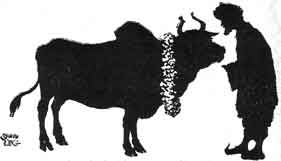
Picture of the owner decorating his ox before the 2nd bet : Internet Sacred Texts Archive

The Sandy Road
The Sandy Road, I think, still falls. under the category of 'don't be a d*ck', but in a different way than the other two stories. Here, the guide makes a mistake, and instead of trying to blame it on other people or anything, he owned up to it and made it right. I respect that a lot! Especially since the guide's entire thought process was, "it's all up to me to make this right, so let's not stop until everything is ok!" Not only that, though, but the guide also marked the well for other travelers to use. How kind of him! I liked this story the best because it rewarded someone for working hard.

Vaga-Buon Voyage!

Bibliography:
Ellin Babbit. "Jataka Tales" http://www.gatewaytotheclassics.com/browse/display.php?author=babbitt&book=jataka&story=monkey

Thursday, February 27, 2020

Reading Notes: Narayan's Mahabharata Part C

Hello VagaBuddies!

The Mahabharata is kicking off! But before I get to the things I didn't like, I want to again go into how much I dislike King Dhritarashtra. He again did a lot of wishy-washy coward-like things such as not yielding to the Pandevas like he should, and ignoring Vidura's advice on how to proceed. However,  he did have a slight redemption in that he realizes his own incompetence, and literally tells Vidura "I am helpless (around my son Duryodhana)." Even if he isn't able to actually make the tough decisions, I at least respect him for recognizing his fate and his weaknesses.

Pandavas in Hiding comic book cover by Anant Pai: Amazon

One story that I really enjoyed in this reading was the story of Yudhishthira's test by his father Yama at the lake. It was a little comical that four of the brothers would all drink the water and "die" (I also don't think they actually die, but get knocked out or go unconscious or something, because that makes more sense). Normally all the brothers being foolish would annoy me, but it seemed at least plausible that someone who was so thirsty wouldn't listen to a random voice on a lake. AND, it also sets Yudhishthira up to be super wise and clever, which I enjoyed. I like stories that involved someone being clever. It also felt justified and logical that it was Yama, the god of Dharma and death, and Yudhishthira's father, to test him. This was also a good way to receive the boon of being incognito for their year in the city without it feeling like it was undeserved or anything! 
Speaking of living in the city, I laughed out load at the part where the brothers and Draupadi were choosing their jobs for the next year. When Yudhishthira announced that he wanted to play dice with the king, I could literally picture exactly the look of doubtful skepticism from each of the brothers and wife! After he had gotten them into exile in the first place with his gambling problem, it was funny to see Yudhishthira go right back to the dice.  
Can't wait to finish the story!
VagaBuon Voyage!

Mahabharata. Narayan. R.K. pp 85-131

Monday, February 24, 2020

Extra Credit Reading: Narayan's Mahabharata B

Hello VagaBuddies!

This week I am covering the second reading of the Mahabharata, Part B! This reading was even crazier than the first reading, covering everything from polygamy to dangerous games of dice to magic bowls of limitless food... also beta-male kings.
King Dhritarasthtra really annoyed me in this reading. He seemed quite powerful and wise and good. earlier in the story, but now he is just weak, easily manipulated, and incompetent; a classic beta-male. I really just wanted King Dhritarasthtra to take a stand, even if it was against the main characters, the Pandavas. Instead he just bent to the will of whomever he was talking to, usually his son Duryodhana. Duryodhana, meanwhile, is a selfish jerk that is bent on revenge, refusing to follow any good advice that doesn't involve hurting the Pandavas. For someone who was supposed to be a really good king, Dhritarasthtra does not seem to be a very good or powerful king now.

Another thing that bothered me about this reading was Yudhishthira's baaaddd gambling addiction. For someone who is supposed to be the wisest of the Pandevas siblings, as well as the leader of the group, I would have assumed him to be impervious or at least resistant to foolish actions like that. Instead, he seems to go against his characterization and gamble away everything he has, including his kingdom, brothers, and wife. Even if it is disrespectful to decline a game invitation, Yudhishthira could have simply played a few rounds at lower stakes and then ended the game early. That would fulfill his obligations as a member of the kshatriya class, while also making the smart decision.

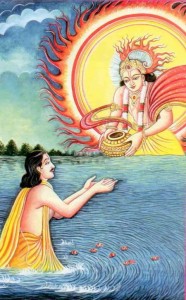
Surya offering Yudhishthira the bowl of limitless food: NY/NJ Bengali

Basically, I dislike characters that make foolish decisions. In this reading, even though he was more vengeful and morally bad, I liked Duryodhana much better, because he was clever and was able to abuse Yudhishthira's weaknesses in order to win. But also he refused to take smart advice, which was not a smart decision.
VagaBuon Voyage for now.

Mahabharata. Narayan. R.K. pp 41-83

Tuesday, February 18, 2020

Reading Notes: Narayan's Mahabharata Part A

Hello VagaBuddies,

This week we ventured away from the Ramayana and into another classic piece of Indian epic literature: The Mahabharata.
Before I started reading though, I needed to pick what version I wanted to read! I settled on Narayan's Mahabharata, mostly because I had access to a physical copy from a friend. I enjoy reading physical copies of books because it's a lot easier to take it around with you and not have to worry about internet access, charging, etc. In addition, reading from a computer has a good chance of letting you get distracted by other assignments, games, incoming emails, etc, so a book seems to be a good option!

The actual reading for this week was very name heavy. It felt like the beginning of the Ramayana all over again, but so much worse. The fact that there was one king, then a first generation of princes and kings, then another generation of princes and kings, and then finally the generation of the Pandavas (5 brothers of various godly fathers; main characters) and the Kauravas (Duryodhana and the hundred other sons of the blind king Dhritarasthtra), was just too much too handle. This is also not even mentioning all the other confusing intertwining stories such as Ganga drowning the first seven sons in the first generation of princes and kings, Karna being set adrift in the river, and other small side stories. It's so hard to keep straight!

Family Tree in the Mahabharata: Mythical Musings on Blogger

I actually originally found this image as part of this reading, but it is actually so good that I will continue to use it as a reference for further on in this story. Glad I found it!

In terms of stories that I liked, I enjoyed the story of the sage/trainer Drona's revenge against his childhood friend. I can appreciate a good revenge arc, and I thought that Drona was very morally good in this to leave his old friend alive and take half his kingdom, using his own words of being equals against him. Definitely foolish because I think that will be another source of tension and conflict in this already complicated web of relationships, but moral nonetheless. I also enjoyed the secrecy and spy-themes throughout the story, exemplified best in the Pandavas' escape from the burning house. So exciting! 

Since I had such a good time reading the Ramayana, I am excited to get invested in this story too, and the names (although super difficult) are slowly getting set in my mind! 

VagaBuon Voyage!


Narayan, R.K. "The Mahabharata" pp. 1-39

Thursday, February 13, 2020

Extra Credit Reading Notes: Sita Sings the Blue, Part B

Hello VagaBuddies,
Welcome part to Sita Sings the Blues review Part 2! In part one,  I also forgot to mention that I noticed that the movie took certain liberties with the story of the Ramayana, which kept it interesting, but one of the more controversial changes (in my mind) was leaving out Lakshmana in Rama's exile into the forest. In Narayan's Ramayana, Lakshmana was there to protect Sita when Rama went to catch the golden deer, but in the movie Sita was left by herself.
In addition to the Lakshmana removal, I also found it odd that the battle between Rama and Ravana was very oversimplified and frankly unsatisfying in this movie. In Narayan's Ramayana, Ravana and Rama battle furiously with different weapons on the ground and in the air on chariots, with tons of trickery and magic throughout the whole fight. In the movie, Rama shoots one arrow that flies straight into Ravana's chest, killing him instantly. This was after all the build up of Ravana as this powerful evil king who was Rama's wife's kidnapper, his arch-nemesis. And his death seemed way too easy for Rama.
Anyway,  story changes aside, I loved loved all the songs in here. Honestly! "Who's that Knocking" was such a bop that I am thinking of just listening to that song anyway!

Trigger Warning, Dave being an absolute d*ck: Sita Sings the Blues

Ok, another thing that I liked (and yet also hated in this movie) was the "real-life" portions of the film about Nina and Dave's relationship. First of all, Dave is a complete asshole. It is a testament to this film's storytelling ability that I disliked Dave so much, that I became so sad when he broke up with Nina over email while she was away in New York. It was interesting to learn that this story arc of the movie was based on real-life events between Nina, the creator of the film, and her boyfriend. The movie has a whole then seemed to be a very cathartic exercise for Nina, and I was happy to get a good film out of it! Overall this movie is a fun, fresh, and exciting adaption of the Ramayana (with only a few questionable choices), and I would recommend this to anyone wanting to learn more about the Ramayana, or just wanting a good story in general.

Vaga-Buon Voyage.

Nina Paley. "Sita Sings the Blues." https://www.youtube.com/watch?v=RzTg7YXuy34&feature=emb_logo

Reading Notes: Sita Sings the Blues, Part A

Hello Vagabuddies,
Today I am reviewing the first half of the the beautiful movie Sita Sings the Blues. I watched it with two other students from our class (and a past student who just wanted to rewatch the movie!), and it was such a fun movie. I really enjoyed the different art styles that were used for different purposes throughout the movie. First, there was the art style of a chalk-style rough animation on flashing cut-out real-world images such as hearts or the sun. Then, there was the art style of the characters talking to each other, which was just a simple animation, and this was separate from the animation during the songs, which was a very distinct cartoon-style animation that over-emphasized the character's body types such as Sita's very very skinny waist and Rama's Dorito chip body. Then there was the style of animation during the narrator's parts that had more realistic drawings but a choppier style of animation. Finally, running parallel to the whole story of the Ramayana, there was the drawn cartoon on real backgrounds animation for the "real life" story between Dave and Nina. This constant switching between animation styles sometimes made the story a little difficult to follow and feel a little disjointed, but overall it kept the film interesting and fast-paced.
Onto more things I liked about this half of the film specifically, the interaction between the narrators among themselves was hilarious! It felt like an episode of Drunk History, and they disagreements and confusion parallels what a first-time reader of the Ramayana feels during their read-through. I especially liked it when the narrators discussed why Sita never escaped with Hanuman, something I had also wondered. The female narrator explained (and I agreed with her) that Sita wanted Rama to save her and prove himself to the world by defeating the evil king Ravana. Other things like the comedic timing of the camera panning to Ravana every time Sita explained her devotion to Rama was hilarious and a definite laugh-out-loud moment!

Ravana's Shock at Sita's devotion: Sita Sings the Blues

In the extra reading due this week, I will discuss what I thought of the songs too (spoiler, I loved them)!

Vaga-Buon Voyage!


Nina Paley. "Sita Sings the Blues." https://www.youtube.com/watch?v=RzTg7YXuy34&feature=emb_logo


Tuesday, February 4, 2020

Reading Notes: Narayan's Ramayana Part D


Hello VagaBuddies

Time for the biggest reading in the whole Ramayana because Part D included the climax of this story!
At the start of this reading, my love of Hanuman was overwhelmingly confirmed when he sneaked into Lanka, Ravana's capital city, to find Sita. To do this, he mastered his supernatural shapeshifting powers, first becoming big enough to cross the sea in a step and then small enough to explore the evil city unnoticed (My monkey dude is magic too!!). He found Sita just in time, because she was close to committing suicide out of despair. Hanuman, who also has a way with words, comforted her and gave her Rama's ring, a token of his commitment to her. Then, Hanuman destroyed much of the city, allowed himself to be captured, and, when he was set on fire for being a spy, spread the fire all across the city, burning much of it down to the ground. I KNEW I LIKED THIS MONKEY FOR A REASON! Much later, after returning back to Rama, while Rama's camp was debating on whether to receive the defecting Vibishana, Hanuman was the sole voice of compassion of Rama's advisers. Hanuman remembered that Vibishana saved his life when he was captured by Ravana, and could feel that Vibishana was virtuous. Basically, Hanuman joined Lakshmana as the strong, wise sidekick who dominates everyone.

More Hanuman. Just cuz : Pinterest

Rama vs. Ravana : Dazzling Goa (WordPress)

Besides other amazing things Hanuman did, this reading also had the climatic fight between Rama and Ravana! Rama, who defeated enemy commander after enemy commander, had enraged Ravana so much that he tried to fight Rama, but was immediately shut down. After recovering, and even bringing in some extra forces and using magic/trickery, Ravana was still losing every battle to Rama and his allies. One thing that did bug me a slight bit though, was when Ravana sent out Vishnu's trident that was supposed to be super destructive, but Rama just chanted a mantra and the trident was useless. I liked it much better when Rama countered Ravana's attacks with a specific asthra that could counter it. He could have easily had a single-use impenetrable shield or something, but instead the trident just failed because Rama said some magic words that had never been mentioned before.
Anyway, I also thought it was interesting that after the battle, Rama made Sita prove herself again, which even Narayan pointed out as self-contradictory based on his response to Sugreeva or Ahalya, who could both return to their spouses after explicit acts of infidelity.
Regardless,  I still really loved the ending, with its heart-pounding action, last-minute saves, and giant party to end it all. Narayan's commentary really came out on the last epilogue, describing how the author tries to draw out the end of the story, and I really liked learning that little bit.

And for my last reading notes for the Ramayana, VagaBuon Voyage!


Narayan, R. K. "The Ramayana" pp 131-171

Monday, February 3, 2020

Reading Notes: Narayan's Ramayana Part C

Hello VagaBuddies,

For this reading in the Ramayana, I was introduced to my new favorite character: Hanuman! But before I get to that beautiful monkey man, I have some honorable mentions.

The beast Hanuman himself: YouTube

First, here is where I finally get a mention of the UFO "Ravana's flying chariot." Although it isn't talked about in great depth, I can still easily see how some conspiracy theorists would latch upon this vehicle as evidence of UFO's in ancient texts. I am just surprised how the 'Ancient Technologies in the Ramayana' video didn't mention how Ravana could fly just by himself (jetpacks anyone?). In general though, this seen was very action packed and exciting.
For my first honorable mention, I want to praise the OG Big Bird: Jatayu. I loved Jatayu's final stand in this reading, which had him give his life towards trying to stop Ravana's kidnapping of Sita. Not only was this translation excellent (having great flow, pacing, and sense of action), but it was also just an incredibly moving scene. This bird, through his devotion to their father Dasaratha, destroyed Ravana's chariot in order to try to save Sita. Although he was ultimately unsuccessful, he died a hero.
NOW IS THE TIME TO TALK ABOUT THE MONKEYS. Ok so backstory: Monkeys are my favorite animal. I read every book about monkeys that was in my grade school's library. Twice. I made a whole monkey-themed activity book, fitted with acrostics, crosswords, word searches, drawings, different monkey-animal combinations, etc. And though I've since grown out of my main monkey-craze, imagine my inner childlike joy at having a smart, strong, and cool monkey character in the form of Hanuman appear in the Ramayana. Not only is this guy incredibly wise, but he is also the son of the wind god, which gives him immense powers besides being a giant monkey. As Rama's greatest devotee, he clearly sees Rama as the incarnation of Vishnu that he is, and is eager to serve him.

This is a Hanuman stan blog now:  Free Wallpapers

Now that this is basically going to be a Hanuman stan account, I am so excited to read more Hanuman stories and see him fight in battle next to Rama.
Bye for now.

Narayan, R. K. "The Ramayana" pp 89-131

Wednesday, January 29, 2020

Reading Notes: Narayan's Ramayana Part B

Hello VagaBuddies!

I can definitely tell that I am getting very into reading the Ramayana. The first reading was tough just because of the names (which all felt like the started with V-I-S then 20 more letters), but now I am getting a hold on the names (mostly) and I am loving the story! It still feels like a classic myth (duh) but that doesn't mean I don't find it new and interesting!
Some of my thoughts on Part B:
Lucy (Kaikeyi)  got what she deserved! Even her own son Bharata, shames her for her actions, and is more concerned with distancing himself from her plot than he is about claiming the throne. I thought that Bharata was especially noble for venturing out on foot to find Rama in the same ascetic clothing (of tree bark?? That seems very uncomfortable, but I guess that's the point). Even when he is unable to convince Rama to return, he still does not claim the throne but uses Rama's sandals to hold Rama's place until his return. During that whole conversation, I also enjoyed how comedic it was to have two people saying "Yours, not mine" instead of fighting over whose kingdom it is. I really liked how the narrator himself got involved with a little commentary on how strange it was.
Soorpanaka (Shurpanakha), who I will now call Sour Pancake based on her appearance after her run-in with Lakshmana, was also a very interesting character here. She reminded me of sirens that would attract sailors to jump overboard with their sweet voices before the sailors realized that all the sirens were monsters. Sour Pancake pretended to be a sweet, beautiful creature who was shunning the ways of her family (which would honestly be a compelling story), but in reality she was a monster who wanted nothing more than be subservient to Rama. When I was reading this story, I was acutely aware that we (the readers) were meant to dislike Sour Pancake from the start. She was definitely very forceful and acted with hostility towards Sita, but Sita hardly did much better when she first laid eyes on Rama. Remember, when the first shared that little glance, Sita had acted rudely to all her attendants and became distraught at the very thought of never seeing Rama again. Sour Pancake is more forceful and hostile, sure, but never very violent. (I am also curious why the Dasaratha the king could have multiple wives and Rama cannot, but it is probably a cultural thing that I don't understand). However, my views definitely changed when she was caught stalking Sita by Lakshmana. She probably should have been killed for that, or when Kara attacked them with his army.
I like this image because it shows Sour Pancake clutching her chopped and bleeding nose : SmileMakerKrishna

Speaking of armies, it was really interesting how what seemed to be a huge fight between Kara and his army vs. Rama and Lakshmana was reduced to the same amount of sentences as the damage dealt by Lakshmana to Sour Pancake. The short description made what I assume was a huge battle into something that didn't seem to matter so much and didn't have much action. Maybe that's the point though. Maybe the point is that the battle was so trivial to Rama and Lakshmana, even if it was a whole army of demons against two people.
Overall, this reading was the one where I got into the story, and I am excited to keep reading!
Vaga-Buon Voyage!

Narayan, R. K. "The Ramayana" pp 53-89

Tuesday, January 28, 2020

Reading Notes: Narayan's Ramayana Part A

Hello VagaBuddies,

Wow. This first reading was a wild ride. Overall, I really enjoyed it. It had all the trappings of an ancient tale: magic and monsters, special weapons and quests, plenty of lore to go around. I am always a fan of myths that explain how the world came to be how it is.
For example, the story of the Horse Sacrifice and the Ganges River. Obviously this story has huge cultural, political, and religious significance for Indian society in that it has the formation of the Ganges River. However, one tiny detail that can be easily overlooked is that it explains the creation of the oceans as the giant holes that were dug in search of the sacrificial horse and then filled by the flow of Ganga.

Bhagiratha praying to Shiva and Ganga, watching the Ganges flow down : HinduGod99

Within this story too, the devotion of Bhagiratha amazes me. I can hardly imagine a grandson praying for tens of thousands of years for the salvation of his entire family. On top of that, he was constantly jerked back and forth by the gods Ganga and Shiva, who seemed to just be competing with each other. I am no stranger to myths, but this story really got to me, since someone devoted their entire life to saving their ancestors, whom he had never met, subsisting on dry leaves or air or rays of sun or nothing at all just to do it. This also served as a good look into Indian culture's veneration of austerity, which has only minor parallels in Western culture, and never with the same effects. Usually I think of hermits as seeking personal salvation in a higher plane, but in the Ramayana, there are countless examples of kings or warriors undergoing severe austerities for special powers, weapons, or favors. It is strange to think of these ascetics as warriors instead of monks.
Finally, I extremely dislike Kaikeyi (whom from here on out shall be referred to as Lucy which is short for Lucifer). She was completely fine with Rama (the god-king incarnate) being king, which was very gracious of her. Then she listens to Krazy Kooni and all of a sudden, Lucy is a [sic] horrible person. It was all an interesting glance into the concept of motherhood in Indian culture; that Lucy was overjoyed at Rama being crowned kind, who she saw as one of her own sons. But noooOOoo00oo, Krazy Kooni had to come and mess it all up. I hope this gets fixed soon, but I have a feeling Lucy is going to stay a [sic] mean person.

Vaga-Buon Voyage

Narayan, R. K. "The Ramayana" pp 1-53

Monday, January 20, 2020

Reading Notes: Week 2 Anthology (The Monkey Who Gathered Lotuses)

Welcome VagaBuddies!

Here is the first reading notes post! I am reviewing story The Monkey Who Gathered Lotuses. Like I said in the previous Week 2 Reading Overview post, I enjoy stories with clever main characters, and this story had two very clever characters! I think it made for a very fun story to see both the Bodhisatta and the Devadatta try to outsmart the other. Ultimately, the Bodhisatta is able to outsmart the Devadatta and even impresses an ogre so much that it becomes his ally. 
The set-up of the story seems very similar to the Greek mythology story of Kronos eating all his godly children so that they could not grow up to fulfill the prophecy that he will be defeated by his children. In that story, Zeus's mother, Rhea escapes to Crete to birth Zeus, similar to how the Bodhisatta's mother escapes give birth to him. However, neither the Bodhisatta nor his mother return to the father Devadatta until the Bodhisatta is old enough to challenge him. 
I also used this story as an opportunity to read a bit more about yakshas, the race of the ogre in this story. Since I am unexperienced with Indian folklore and mythology, I am still unsure if the ogres (called a water demon in the introduction) is necessarily evil, or if it is just (as the Wikipedia page suggests) mischievous, capricious, or whimsical. In this story, the ogre seems more whimsical because it helps Bodhisatta carry the lotuses and becomes his ally, yet also the ogre would normally eat all the travelers that came into the water. Further reading on the yakshas seems to suggest that they are normally benevolent or neutral creatures, not necessarily evil, but I can't wait to read more stories with them!

File:Mudgarpani Yaksha, Mathura, 100 BCE.jpg
Mudgarpani Yaksha statue from the Mathura Museum dated around 100 B.C.E: Wikipedia Commons

As an optimist, I do also like that the story has a happy ending, and that the 'good' monkey is the victorious one. It is also interesting how Devadatta wasn't even killed in this story out of revenge by Bodhisatta. Instead, he died of fear/anguish. Bodhisatta won without even having to get blood on his hands, keeping him as an incredibly pure character. 
Im excited to compose a story based off this!

Vaga-Buon Voyage!


Bibliography:
Chalmers, Robert. "The Monkey Who Gathered Lotuses" Tayodhamma Jataka, Jataka Volume 1. https://sacred-texts.com/bud/j1/j1061.htm

Week 2 Reading Overview

Welcome VagaBuddies!

In answer to all your questions about which version of the Ramayana I will read....
I have decided.....
To choose....


NARAYANA'S RAMAYANA
(the crowd goes wild "ahhhh")

For me, it came down to the fact that I can always get background information, notes, etc,  but having a singular writing style throughout the whole story will be nice to keep the flow of the story going. I also like the idea that this is sort of a "third-generation" story, in that it was based on a story based on a story. The other version of the Ramayana, despite how interesting it looked, also seemed to have less of a distinct "ancestry" than Narayana's version. I am excited to dive right in!

For the comic book section of this assignment, I chose Vishvamitra: The King Who Became an Ascetic and The Pandavas in Hiding: Outwitting a Wily Enemy. I chose the Pandavas story because it seems like it has a very clever main character (the title uses the word 'outwitting'). I really enjoy stories where the main character is clever in some way and proceeds logically. I get frustrated when characters make wholly illogical decisions such as giving the villain a second chance for no good reason. (Side note: I want to be clear that I am ok if the character has any sort of justification for his actions: the villain was family, the hero is morally good, etc. etc.; I just need something). I chose the Vishvamitra comic book because it seemed like an interesting story. Vishvamitra seems to be a really compelling character that works hard but also doesn't always act morally.

For the videos, I watched the Ancient Technology video and the Sanskrit in 60 seconds video. Ancient technology and subjects similar to that (like Ancient aliens and conspiracy theories in general) are a sort of guilty pleasure for me. I don't really believe them, I just think that it is interesting to think that all the talks of flying vehicles in ancient texts could have been aliens. My favorite of the two, though, was the Sanskrit video. As a linguistics major, I really enjoy learning about other languages, and I am always trying to develop my language acquisition skills. The video itself left a little bit to be desired. If you watch, I recommend reading the top comment by Jaskaran Mangat that gave some excellent background information and corrections to things said in the video. Overall a sub-par introduction to a fantastically amazing language.

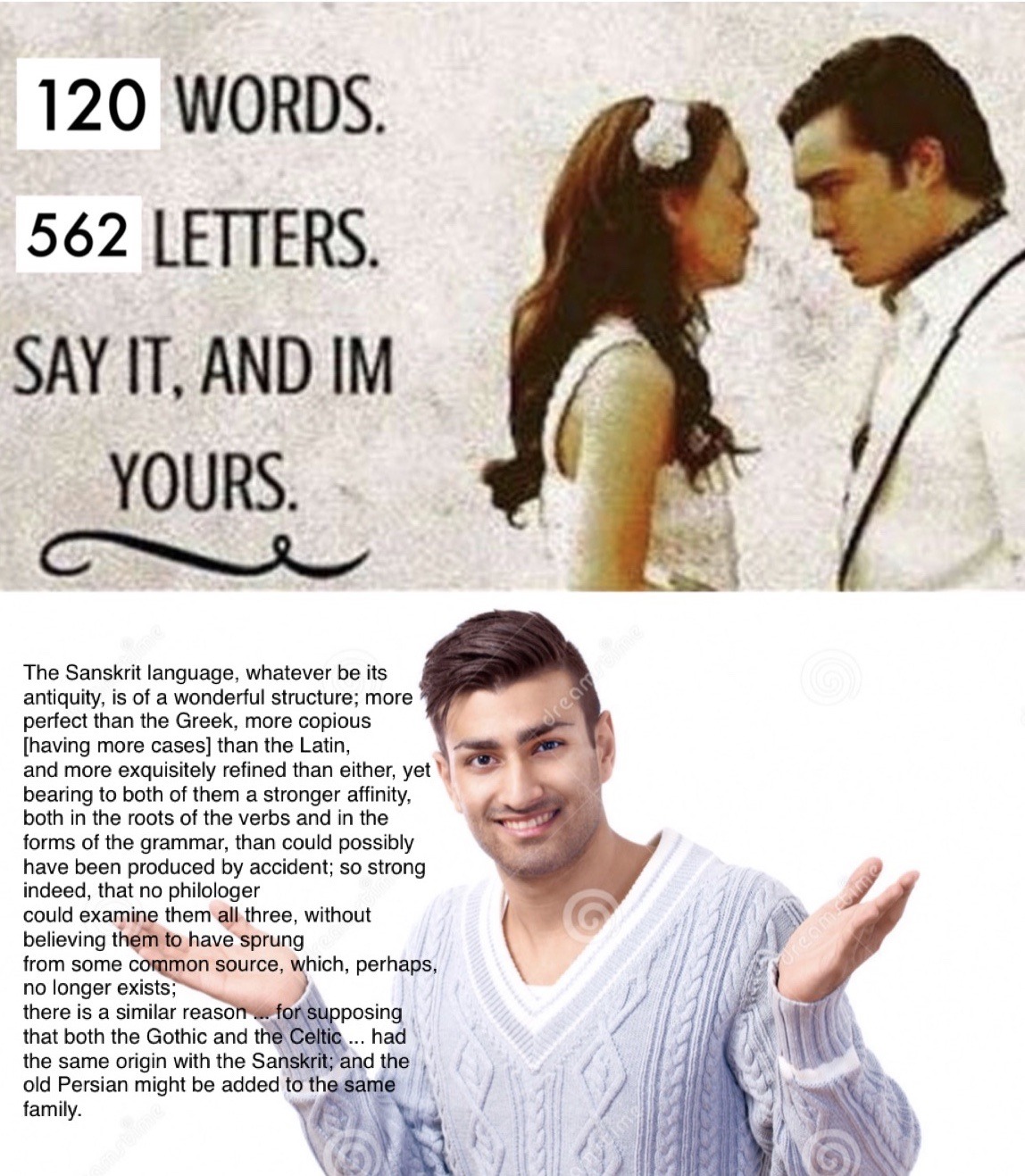
image
A linguistics meme based on a quote about Sanskrit by William Jones: Tumblr

Vaga-Buon Voyage!