Showing posts with label Sanskrit. Show all posts

Thursday, January 30, 2020

Topic Research: Understanding Sanskrit and the Sounds of Sanskrit

Hello VagaBuddies,

At much encouragement, and with genuine curiosity, I have decided to do a storybook focusing on Sanskrit! (probably a death sentence but we will see!)
For this week's research, I decided to just focus on some of the sounds of Sanskrit and becoming familiar with how the language sounds. First, I started at Valmiki's Ramayana, which gave a wonderful page that allowed me to see the original Sanskrit, the romanticized Sanskrit, an English language, and English commentary about the passage, all at once! For about 15-20 minutes, I just tried to follow along the romanticized script! Even just that was pretty difficult!

A necessary phrase after trying to follow along Sanskrit : Illumine

After struggling through this a little bit, I decided to try to find linguistic descriptions of the sounds that Sanskrit uses that aren't in English, so I could try to familiarize myself with those sounds before I went back to trying to follow along. English already has a lot of vowels, so luckily I didn't have much to learn there, just a few consonant-vowel mergers such as ɽɪ (think of a classed rolled 'r' but only doing one tap instead of the full roll, and saying the vowel from 'sit' at the same time). For my own notes (or for other interested people), here are all the vowels of Sanskrit:

IPA Nagari IAST English approximation
ɐ अ, प         a         comma
aː आ, पा ā         bra
ɪ इ, पि         i         sit
iː ई, पी         ī         feet
ʊ उ, पु         u         look
uː ऊ, पू         ū         loot
ɽɪ ऋ, पृ         ṛ         as rri
ɽiː ॠ, पॄ         ṝ         as rrī
lɪ ऌ, पॢ         ḷ         as lli
liː ॡ, पॣ         ḹ         as llī
eː ए, पे         e         wait
ai ऐ, पै         ai         hi
oː ओ, पो o         old
au औ, पौ au         h'ow
◌̃ ँ         ◌̃/m̐ nasal vowel [ɐ̃], [ãː], [õː], etc.) *

*ok I have only like half an idea what this vowel is supposed sound like. 

The consonants of Sanskrit were a bit trickier. For the non-linguists, we describe consonants with three characteristics: where the sound is made with the tongue (the place of articulation), how the sound is made (manner of articulation), and whether you use your vocal cords or not (voicing). For example, the [p] in 'pit' would be described as a voiced (vocal cords are engaged) bilabial (made at your lips) stop (you one puff of air and then none more). One important note about Sanskrit is that it makes a distinction between aspirated consonants and un-aspirated consonants. In English, this would be like if the [p] sounds in 'pie' and 'ripe' were completely different letters. In 'pie' we also release a little bit of air when we make the [p] sound (called aspiration), but we don't when we make the [p] sound in 'ripe.' That tiny difference to us would be as clear as the difference between [b] and [p] to Sanskrit speakers, so it's something that I should watch for.

For next week's research topic, I want to delve further into what stories I could use. Right now, I still really enjoyed the Ganges Origin story that I talked about in my Ramayana Reading A Notes and the Story of this week, so I would like to use that story. Potentially focusing in-depth on a couple words to discover the full breadth of their meaning, or using a couple short mantras to describe broad trends in the stories! We will see next week!
Vaga-Buon Voyage

Sunday, January 26, 2020

Wikipedia Trail: "Sanskrit" to "List of English Words of Sanskrit Origin"

Hello Vagabuddies!
Welcome to my first ever Wikipedia trail. I often find myself mindlessly trekking through Wikipedia's pages, so I might as well get some class credit for it!
For this time, I decided to dive into Sanskrit, since I am looking into having Sanskrit as the central theme for my storybook. And, as a linguistics major, I always enjoy a good foreign language.

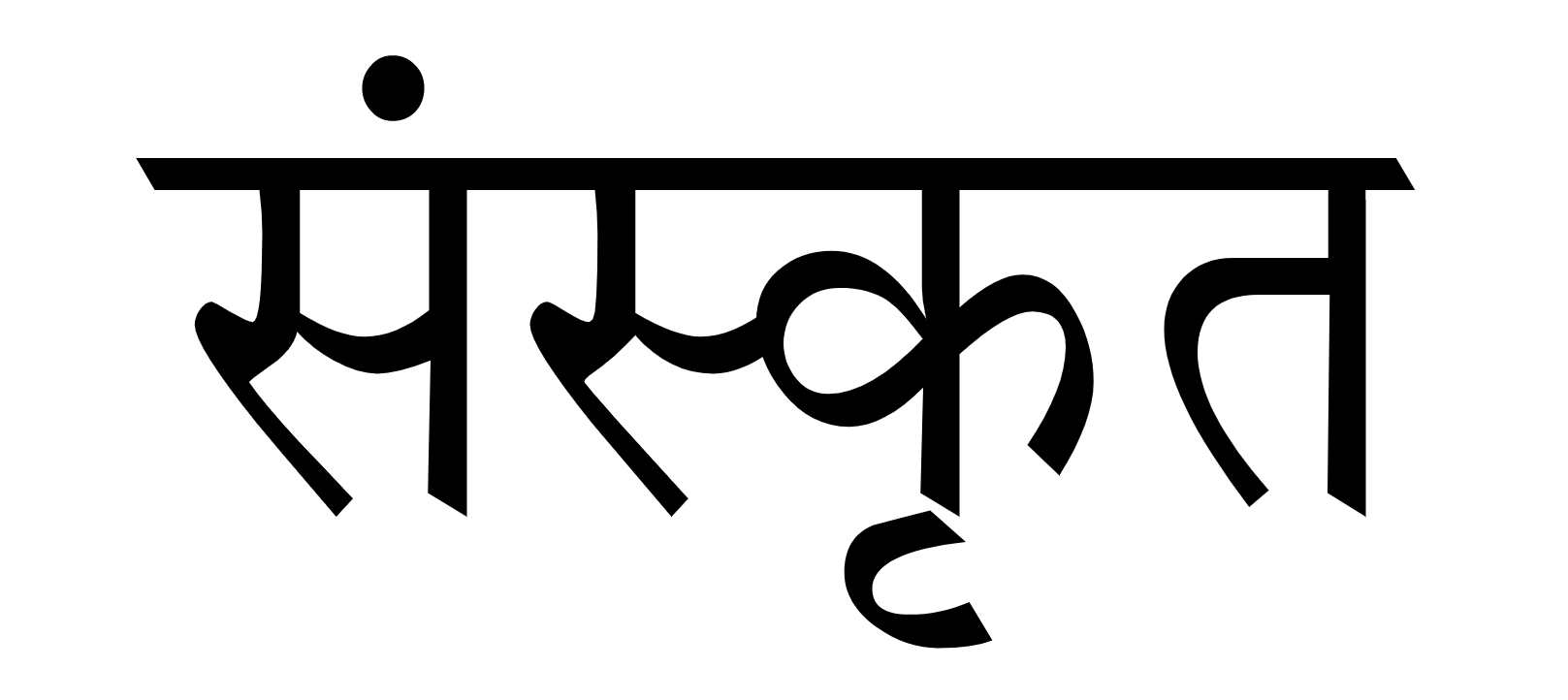
The word संस्कृत (Sanskrit) in Sanskrit.jpg
Sanskrit in Sanskrit : Wikipedia Commons

Page 1: Sanskrit
This was a pretty basic starting point. I am learning about Sanskrit, so start with the basics, right? Here are some of what I thought were important takeaways. First, basic facts, Sanskrit is an Indian language with deep religious, cultural, and political significance. However, it has also migrated with its speakers throughout Asia, and has subsequently played a major role in many of the religious traditions of Asia such as Hinduism, Buddhism, and Jainism,  to name a few. Second, Sanskrit is not only part of the Indo-European language family, which makes it related to everything from Latin and Greek to German and Russian (which I had known), but it is also one of the oldest, documented languages of the world, dating back to the 2nd millennium BCE. Third, there are actually two forms of Sanskrit: Vedic Sanskrit (the language of ancient India) and Classical Sanskrit (the newer, standardized form of Sanskrit).

Page 2: Sanskrit Literature
In this first descent, I decided to dive more into the literary significance of Sanskrit, which lead me to practically every major Indian religious text. In keeping with a pattern seen across all cultures, language and religion go hand-in-hand, which meant that most of the oldest writings of Sanskrit are religious texts.
Bhagavad Gita written in Sanskrit (left) and translated into a Latin script (right) with an English translation (middle) and English commentary (bottom) : QuotesGram

Page 3: Sanskrit Revival
This title interested me, not only because language revivals are fascinating (see the wildly successful Maori Language Revival in New Zealand), but because this implied that Sanskrit needed reviving. This confirmed for me what I was thinking, that Sanskrit, though still spoken today, was mainly contained within a religious sphere. In fact, only about 0.002 % of India's total population (still around 25,000 people) speak Sanskrit as their first language. This percent expands to a still-tiny 0.19% of Indias population when the category expands to speakers of Sanskrit in general. I also learned here that Sanskrit was never an official language of any Indian state until it became one of the official languages of Uttarakhand in 2010.

Page 4: List of English Words of Sanskrit Origin
This final deviation was mostly for fun, and I honestly wasn't expecting too many English words to have Sanskrit origins. BOY WAS I WRONG. Out of the 100+ words, here are some of my favorites: Avatar, Bandana, Candy, Cheetah, Crimson (!!), Juggernaut, Loot, Pundit, Sapphire, Shampoo, and Tank.

Friday, January 24, 2020

Topic Brainstorm for a Vaga-Project: TikTok, Sanskrit, Ancient Aliens, and Italy

Top Four Storybook Ideas:

  •  If Ramayana Characters were on TikTok...
Tiktok is a new social media platform centered around short videos, often with a song or other audio playing over the video. It has a wide range of content from comedy shorts, dance trends, challenge videos, and sometimes just hot people staring into cameras (which somehow gets huge amounts of likes). If the characters of the Ramayana were on TikTok, what would their accounts look like? Would Hanuman create original funny skits? Would Ravana make "social experiment" prank videos as an excuse to do something mean to strangers? Would Sita have a makeup tutorial account? Would Rama film himself trying to learn the hot new dance? I think there is a lot of potential in this idea, and perhaps they all share their scripts with each other for feedback. Or maybe someone else is writing a review of all their best videos? 
This project would be similar to this Dating Profile storybook in that each character would have their own page in the storybook to develop their personality, their connection to the theme, and their connection to each other. 

Top 10 Tik Tok Celebrities In India and Their Followers ...
Potential Lineup of the four main characters? : The Live Mirror

  • Sanskrit and Indian Epics
The Ramayana and the Mahabharata are the two great Indian epic poems, and they were both written in Sanskrit. As one of the oldest still-spoken languages in the world (the most ancient form dates back to the second millennium BCE), Sanskrit is intimately tied to the history of India. Just as a study of ancient Romans like Caesar or Cicero is enhanced with a little bit of knowledge about Latin, I think that this class over the Indian epics would be enriched by a little understanding of Sanskrit. As a linguistics major, I love learning about other languages, and this would be the first language I study that doesn't use the Latin alphabet. What a challenge!
  • Ancient Aliens
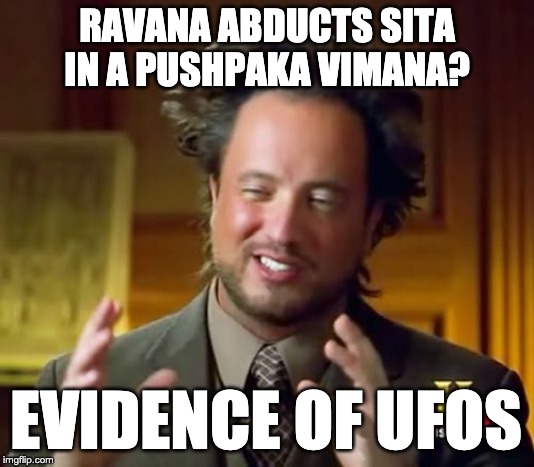
I don't really subscribe to conspiracy theories, but I find them so fascinating. Because these conspiracy stories often start with an unexplained phenomenon, such as myths of flying vehicles, I find these explanations interesting (think the Ancient Technology video from Youtube playlist of India-related videos). I think for this idea, I could try to place myself as a time traveler in these stories that have unexplained phenomena, and then I could "explain" all the phenomena as a modern-day scientist. I would love to find modern-day inventions and studies that relate to the fantastical topics that are described in these ancient texts!

Ancienct Aliens Meme, self-made : ImgFlip

  • Italian Ramayana?
This is probably my least developed idea (hence why it is last), but I have a lot to work with. I rewrite several stories from the class, but it in modern-day Italy. Having spent a few months immersed in Italian culture as much as I could (and since I have several Italian friends), it might be interesting to put those characters and stories into an Italian context (leaning into some Italian stereotypes). Instead of traditional Indian food,  the characters could eat pasta ragu or lasagne. Instead of the Indian social hierarchy, there would be the Italian familial system where all family members live together until you are married after turning at least 30. I can even write in some dialogue, phrases, or short stories in Italian to keep it interesting! I guess maybe I am just looking for an excuse to practice my Italian in some way, but it's definitely an idea with some substance!

---
Those are my top four ideas for a storybook project, and I can't wait to hear some feedback about it! If you're in my class, let me know which storybook you'd read! If you're not in my class, you're probably my mom so hi mom! Thanks for loading me up with groceries and doing my laundry last time I visited home!

Alright, Vaga-bye for now!

Monday, January 20, 2020

Week 2 Reading Overview

Welcome VagaBuddies!

In answer to all your questions about which version of the Ramayana I will read....
I have decided.....
To choose....


NARAYANA'S RAMAYANA
(the crowd goes wild "ahhhh")

For me, it came down to the fact that I can always get background information, notes, etc,  but having a singular writing style throughout the whole story will be nice to keep the flow of the story going. I also like the idea that this is sort of a "third-generation" story, in that it was based on a story based on a story. The other version of the Ramayana, despite how interesting it looked, also seemed to have less of a distinct "ancestry" than Narayana's version. I am excited to dive right in!

For the comic book section of this assignment, I chose Vishvamitra: The King Who Became an Ascetic and The Pandavas in Hiding: Outwitting a Wily Enemy. I chose the Pandavas story because it seems like it has a very clever main character (the title uses the word 'outwitting'). I really enjoy stories where the main character is clever in some way and proceeds logically. I get frustrated when characters make wholly illogical decisions such as giving the villain a second chance for no good reason. (Side note: I want to be clear that I am ok if the character has any sort of justification for his actions: the villain was family, the hero is morally good, etc. etc.; I just need something). I chose the Vishvamitra comic book because it seemed like an interesting story. Vishvamitra seems to be a really compelling character that works hard but also doesn't always act morally.

For the videos, I watched the Ancient Technology video and the Sanskrit in 60 seconds video. Ancient technology and subjects similar to that (like Ancient aliens and conspiracy theories in general) are a sort of guilty pleasure for me. I don't really believe them, I just think that it is interesting to think that all the talks of flying vehicles in ancient texts could have been aliens. My favorite of the two, though, was the Sanskrit video. As a linguistics major, I really enjoy learning about other languages, and I am always trying to develop my language acquisition skills. The video itself left a little bit to be desired. If you watch, I recommend reading the top comment by Jaskaran Mangat that gave some excellent background information and corrections to things said in the video. Overall a sub-par introduction to a fantastically amazing language.

image
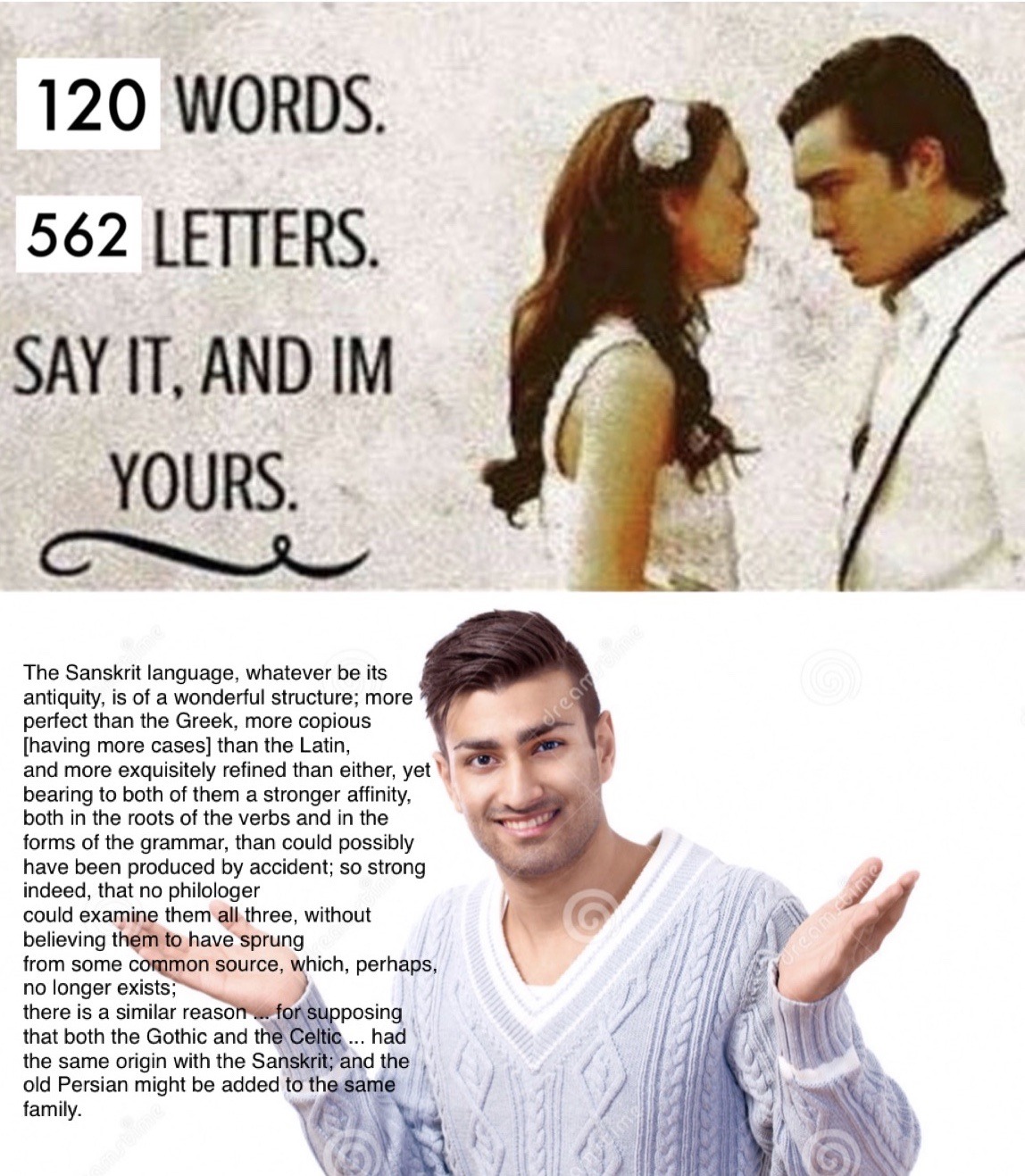
A linguistics meme based on a quote about Sanskrit by William Jones: Tumblr

Vaga-Buon Voyage!